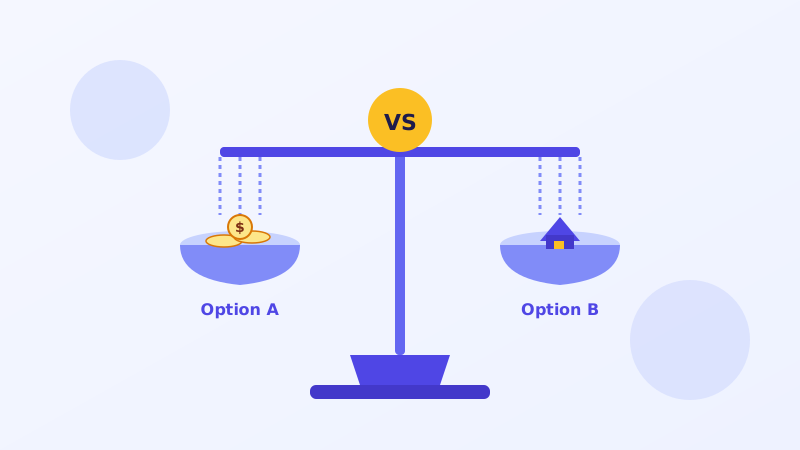
The 30-Second Answer
Pay off any debt with an interest rate above 7-8%. Invest the rest.
Why? Long-term stock market returns average 7-10% annually. Debt above 8% beats that guaranteed. Debt under 6% is being inflated away while your investments grow faster. Between 6-8% is a judgment call.
The Proper Priority Order (Almost Everyone)
- Build a 1-month emergency fund first. Otherwise any setback puts you back in debt.
- Capture the full 401(k) employer match. This is a 100% instant return — ignore it and you're leaving free money.
- Crush all debt above 8% APR. Credit cards, payday loans, personal loans. These are financial emergencies.
- Build 3-6 months of expenses in a high-yield savings account.
- Max tax-advantaged accounts: HSA > Roth IRA > 401(k) to limit.
- Pay down mid-rate debt (6-8% APR) while investing simultaneously.
- Invest everything else. Taxable brokerage, index funds.
- Low-rate debt (under 5%, e.g., mortgage, student loan) — let inflation eat it. Don't accelerate.
Why the 8% Threshold?
Historical S&P 500 return: ~10% nominal, ~7% real. After tax on capital gains and accounting for volatility, the reliable expected return is closer to 6-7% real. Paying off debt is a guaranteed return equal to the interest rate. So:
- Debt at 8%+ = pay it off (beats likely investment return)
- Debt at 5-8% = either path is reasonable
- Debt under 5% = invest instead
The Psychological Override
Math says don't rush to pay off a 4% mortgage. Psychology sometimes says to anyway — some people function better debt-free even at a mathematical cost. That's valid. Here's when to override the math:
- Debt keeps you awake at night
- You're near retirement and want fixed low expenses
- The debt's payments crowd out meaningful savings
- You worry about job loss in your industry
Student Loans: A Special Case
Federal student loans are unlike other debt:
- Often 4-7% rates (low to moderate)
- Flexible repayment options (income-based, SAVE plan, PAYE)
- Potentially forgivable (PSLF for public service, IDR forgiveness at 20-25 years)
- Discharged upon death in most cases
- Interest may be tax-deductible up to $2,500/year
Don't rush to pay these off unless your rate is >7%. Invest instead, preserve liquidity, and re-evaluate if rates change.
Credit Card Debt: The Emergency Case
Average credit card APR in 2026: ~22%. This is financial suicide. If you have $10,000 in credit card debt at 22%, paying only the minimum you'll pay $30,000+ over 18+ years and the balance will never actually go down. Stop investing everything except 401k match. Attack credit cards with every extra dollar.
Mortgage: Almost Always Keep
30-year fixed mortgages in 2020-2022 were 3-4%. These are money machines. Inflation is eroding the real value of your payments while your house (hopefully) appreciates. Paying extra on a 3% mortgage is roughly equivalent to earning 3% tax-free — worse than almost any investment. Keep the low mortgage, invest elsewhere.
But if you got a mortgage in 2024-2025 at 7%+, paying extra starts to make sense mathematically.
The Order for Someone Starting Fresh
Suppose you're 25, $60k salary, no debt, no savings:
- Emergency fund: $1,000 starter, then 3 months expenses
- 401(k) to full match (usually 3-6% of salary)
- Max Roth IRA ($7,000/yr)
- Max HSA (if eligible)
- Max 401(k) ($23,500/yr) if you can
- Taxable brokerage for the rest
- In 30 years you retire with roughly $2-3M
The Order for Someone with Debt
Same 25-year-old, but with $25k in student loans at 6% and $5k credit card at 22%:
- $1,000 starter emergency fund
- 401(k) to match only (not more)
- Attack credit card with everything else — pay off in 6 months
- Build emergency fund to 3 months
- Max Roth IRA + continue paying student loans on schedule (they're at 6%, borderline)
- After 3-4 years, debt-free with investments growing