Compound Interest Calculator
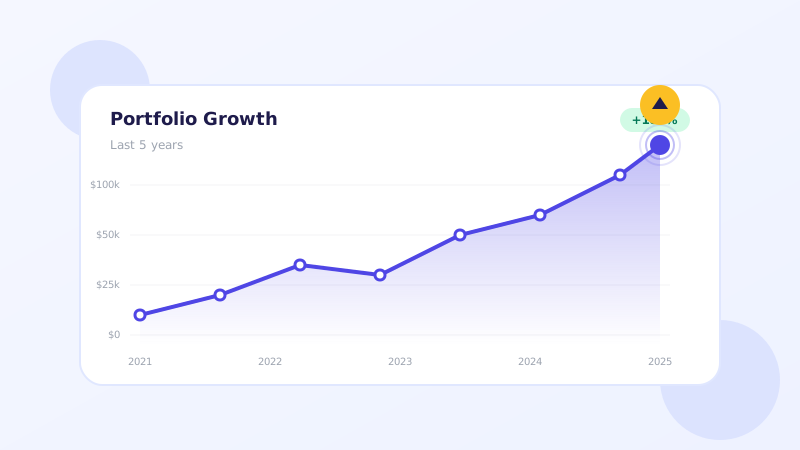
Year-by-year projection of your investment growth. See how the numbers change with rate, time, and contributions.
401(k) Projector
Project your retirement balance with contribution rate, employer match, and decades of compound growth.
How Much to Retire?
The 25× rule, 4% safe withdrawal, and how to calculate your real FI number.
Pay Off Debt or Invest?
The math, the psychology, and when each answer is right.
What Should a Beginner Invest In?
For 95% of people, the answer is boring and correct: low-cost, broad-market index funds. Specifically, a Total U.S. Stock Market ETF (VTI, SCHB, ITOT) and a Total International Stock ETF (VXUS, IXUS). Add a Total Bond ETF (BND, AGG) if you want more stability.
Target-date retirement funds (the "2065 fund" in your 401(k)) are also excellent — they auto-diversify and auto-rebalance as you age. One fund, done.
Stocks vs Bonds vs Index Funds
Individual stocks
Buying Apple, Tesla, Nvidia, etc. High potential return, high risk, hard to beat the market long-term. 90%+ of active fund managers underperform the S&P 500 over 15 years. If individual stock picking sounds fun, budget it as entertainment money, not your retirement strategy.
Bonds
Loans to governments or corporations. Lower expected return (~3-5%), lower volatility. Good for stability and income in retirement. Younger investors typically hold very few bonds.
Index funds & ETFs
A single fund that holds hundreds or thousands of stocks. Expense ratio 0.03-0.20%. You match the market's return, which beats most professionals.
Retirement Account Types
- 401(k) / 403(b) — employer-sponsored, $23,500 limit in 2026. Pre-tax or Roth option.
- Traditional IRA — $7,000 limit, pre-tax (income limits apply for full deduction)
- Roth IRA — $7,000 limit, after-tax contributions grow tax-free. Income limits.
- SEP IRA / Solo 401(k) — for self-employed; higher limits
- HSA — $4,400/$8,750, triple tax-advantaged if eligible
- Taxable brokerage — no limits, no tax deferral, full flexibility
The Right Order to Invest
- Build a 1-month emergency fund in a high-yield savings account
- Contribute to 401(k) up to the full employer match (free money)
- Pay off high-interest debt (credit cards, payday loans, 7%+ APR)
- Fill the rest of your emergency fund to 3-6 months
- Max HSA (if eligible)
- Max Roth IRA
- Max 401(k) to the $23,500 limit
- Invest in taxable brokerage
Dollar-Cost Averaging vs Lump Sum
Got a $50k windfall? Research (from Vanguard and others) says lump-sum investing beats dollar-cost averaging about 2/3 of the time, because markets rise most of the time. But DCA wins on the psychological side — it reduces regret if the market crashes right after you invest. Pick the one you'll actually follow.
Risk Tolerance & Portfolio Allocation by Age
A classic (simplified) rule: % bonds = age - 20. So a 30-year-old holds 10% bonds, 90% stocks. A 60-year-old holds 40% bonds, 60% stocks. In 2026, with longer lifespans, some advisers use age - 10 or even age - 20 aggressively. The key: as retirement nears, reduce volatility.
What to Avoid
- Individual stock picking based on Reddit hype — entertainment, not investing
- High-fee mutual funds (expense ratio > 0.5%)
- Variable annuities with commissions
- Whole life insurance as investment — it rarely beats term + invest the difference
- Day trading — studies show ~90% lose money over time
- Crypto as core holding — speculate with money you can lose, not your retirement
The Biggest Mistake: Not Starting
Time in the market beats timing the market. A 25-year-old investing $300/month at 8% retires with $1M. A 35-year-old investing the same $300/month ends with $450K. You can't catch up by working harder — only by starting earlier. Start today with whatever amount you can.